![[personal profile]](https://www.dreamwidth.org/img/silk/identity/user.png)
Treveri, Belgae, Walloon, Francs
Sep. 14th, 2012 07:42 pmSilva Carbonaria, the "charcoal forest" was the dense old-growth forest of beech and oak that formed a natural boundary during the Late Iron Age through Roman times into the Early Middle Ages across what is now Belgium.
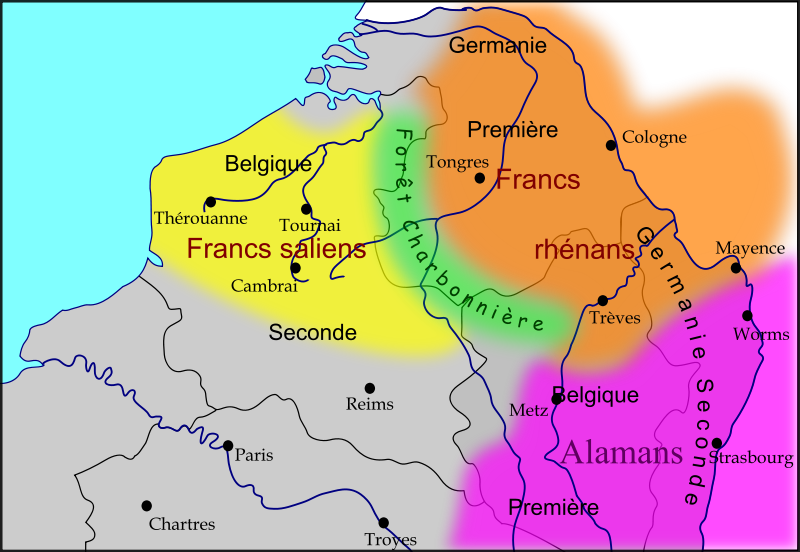
When the Franks settled on the left bank of the Rhine in the fourth century, the Salian Franks rapidly occupied the flat open country with its coastal marshes, and the mixed tribal groups that Romans called Belgae withdrew to the wooded south; there the Romanized Celts—the "Wala" or "strangers" to the Germanic Franks—continued speaking a Late Latin: their label as Wala survives in Walloon. For a time in the sixth century, the Silva Carbonaria formed a barrier between the West Frankish kingdom of Clovis and the East Frankish kingdom of Sigebert the Lame.
The charcoal—which gave the forest its name and into which the once seeming inexhaustible woods were slowly converted—was required to fuel the scattered smelting furnaces that forged the plentiful iron found in outcroppings laid bare by riverside erosion. Even before the Romans arrived, iron weapons forged in the Silva Carbonaria were traded by the Belgae to their cousins in the southeast of Britain.
Archaeologists Discover Germany’s Oldest Roman Military Camp
An archaeological team from the Johannes Gutenberg University in Mainz has discovered the precise location of the oldest Roman military fortification known to date in Germany – in the vicinity of Hermeskeil, a small town some 30 km southeast of Trier in the German federal state of Rhineland-Palatinate.
The camp was built during Julius Caesars’ Gallic War in the late 50s BCE. Nearby lies a late Celtic settlement with monumental fortifications known as the ‘Hunnenring’ or ‘Circle of the Huns,’ which functioned as one of the major centers of the local Celtic tribe called Treveri.
When the Franks settled on the left bank of the Rhine in the fourth century, the Salian Franks rapidly occupied the flat open country with its coastal marshes, and the mixed tribal groups that Romans called Belgae withdrew to the wooded south; there the Romanized Celts—the "Wala" or "strangers" to the Germanic Franks—continued speaking a Late Latin: their label as Wala survives in Walloon. For a time in the sixth century, the Silva Carbonaria formed a barrier between the West Frankish kingdom of Clovis and the East Frankish kingdom of Sigebert the Lame.
The charcoal—which gave the forest its name and into which the once seeming inexhaustible woods were slowly converted—was required to fuel the scattered smelting furnaces that forged the plentiful iron found in outcroppings laid bare by riverside erosion. Even before the Romans arrived, iron weapons forged in the Silva Carbonaria were traded by the Belgae to their cousins in the southeast of Britain.
Archaeologists Discover Germany’s Oldest Roman Military Camp
An archaeological team from the Johannes Gutenberg University in Mainz has discovered the precise location of the oldest Roman military fortification known to date in Germany – in the vicinity of Hermeskeil, a small town some 30 km southeast of Trier in the German federal state of Rhineland-Palatinate.
The camp was built during Julius Caesars’ Gallic War in the late 50s BCE. Nearby lies a late Celtic settlement with monumental fortifications known as the ‘Hunnenring’ or ‘Circle of the Huns,’ which functioned as one of the major centers of the local Celtic tribe called Treveri.

